

How Black Swan Living Cornered the Housing Market
The story of how Black Swan Living/Black Swan Real Estate cornered the housing market in Rochester, Minnesota.
Rochester, Minnesota has experienced quite the boom since the Mayo Clinic announced their plans for Destination Medical Center in 2013, with many rental companies experiencing increased opportunities as an influx of renters entered the area. As Rochester’s population increased, home building ramped up to ensure the new flock of residents and doctors coming to work at Mayo had nicer places to live, and many people, in what we would consider “starter homes,” began to upgrade. Many of these homes became open to people looking to buy their first homes, and for a while, they were actually affordable. According to the Maxfield Research study Rochester had conducted in 2014 (which they followed up with again in 2020 and 2025), Rochester had a 1.2% vacancy rate in “affordable rental apartments.” 5% is considered a healthy amount, anything less showing that there is additional demand. Because of the lack of affordable rental housing available, many people decided buying a small house was a much more feasible option. At the time this article was written, Rochester was described as being “on the verge of a housing crisis.” Enter Black Swan.
The story of Black Swan Living as we know it starts back in 2016 (though they started it in 2011), when Nick and Dr. Elaine Stageberg moved to Rochester, Minnesota and purchased their first home in the area, the first of many in Olmsted County. Coming from humble beginnings, Nick’s fast moving domination of housing in Rochester and the surrounding area showcases how greed affects the lives of thousands of others. As a property management company, they manage well over 200 properties in Rochester. A benefit of controlling so much of the single family home rental market means setting your own prices, driving up prices for everyone in the area, allowing you to label it as “market rate.”
Nick and Elaine don’t only own Black Swan Living, they also own Black Swan Real Estate. This company is the driving force behind acquisitions of properties, and the company investors will interact with when looking to work with a private equity firm. They focus on something called the “Blue Ocean Strategy” which, directly from their website, says “We favor investing in blue ocean markets that are yet to be fully explored and exploit the opportunities that come with it.” They recognized the opportunity that comes with a market that has a lack of competitors, and while many rental companies in Rochester and the area do own their own properties that they use for passive income, Black Swan Real Estate has been the most brazen and aggressive about it.
At the time of posting, entry into their private equity investment funds requires a $25,000 investment, down from the $100,000 requirement originally. They have also been smart enough to put their “deal decks” for their most recent funding campaign, the Secure Freedom Fund, behind a pop-up form to access. These deal decks show what they plan on buying, what they have already bought, and details the types of properties they are interested in. The Secure Freedom Fund originally closed on March 30th of 2025, but has since reopened, something that may be attributed to the USDA loan they applied for to purchase the Villages at Essex Park being pushed back due to the government shutdown that started on October 1st.
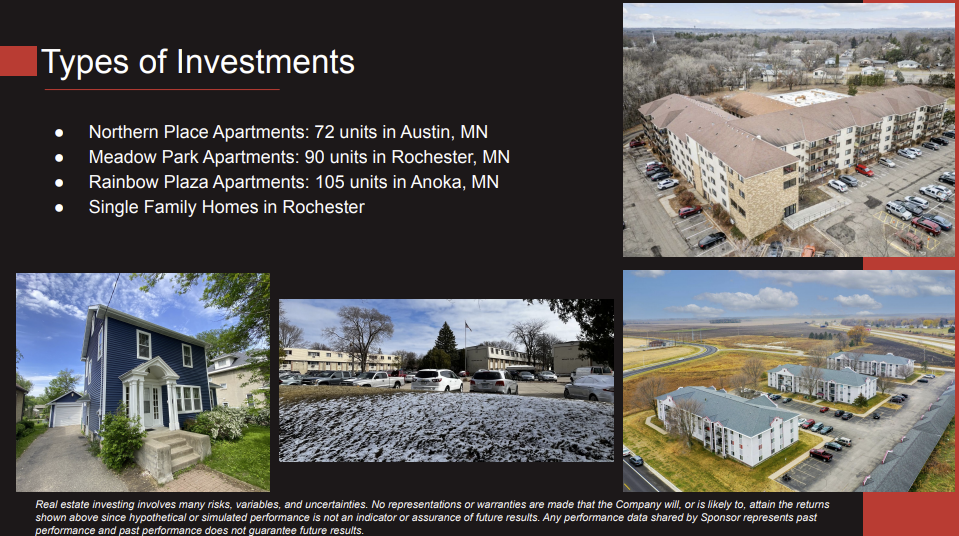
With the Secure Freedom Fund originally, they were looking to fund purchases of three apartment complexes and additional single family homes in the Rochester area.
With most of their funds requiring a minimum of a $100,000 buy-in, they have millions of dollars ready to go at a moment’s notice, usually being utilized to buy single family homes they are interested in acquiring. I have heard and experienced multiple instances of friends, coworkers, young couples, and others going to bid on a home, and their realtor telling them that Black Swan was also bidding on the home. When you have millions of dollars ready to go at any point in time, it’s quite easy to outbid first time home buyers who are stuck with a budget. Who cares if you pay $30,000 over asking price if it means you get another property to use in your portfolio?
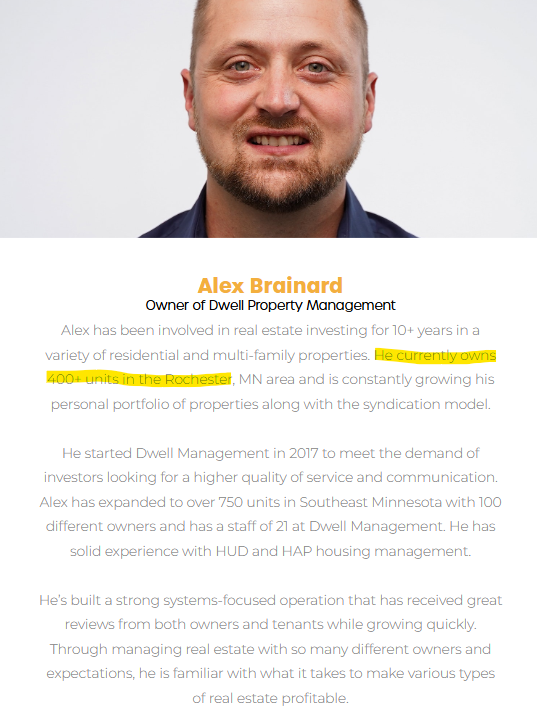
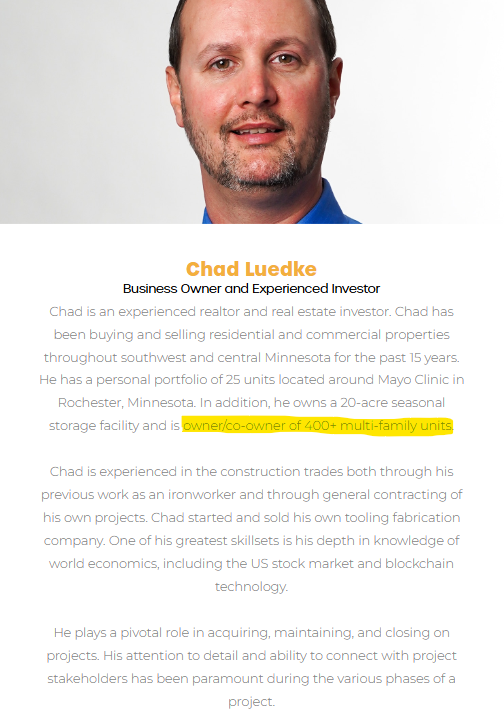
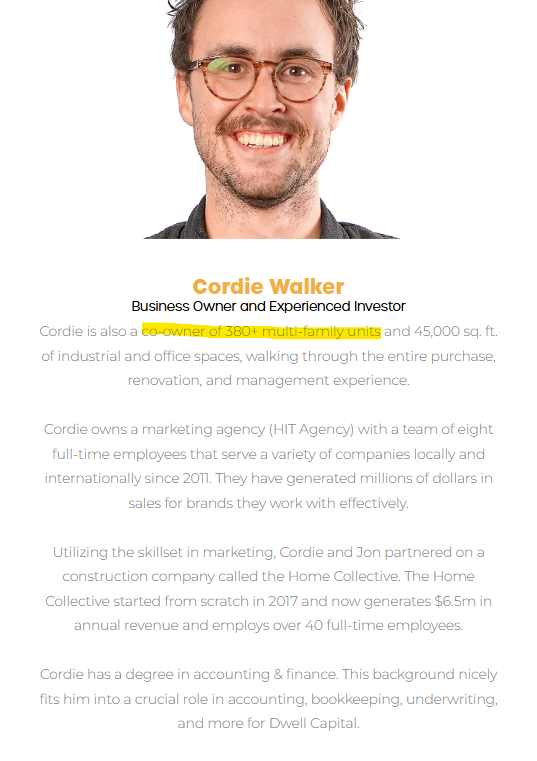
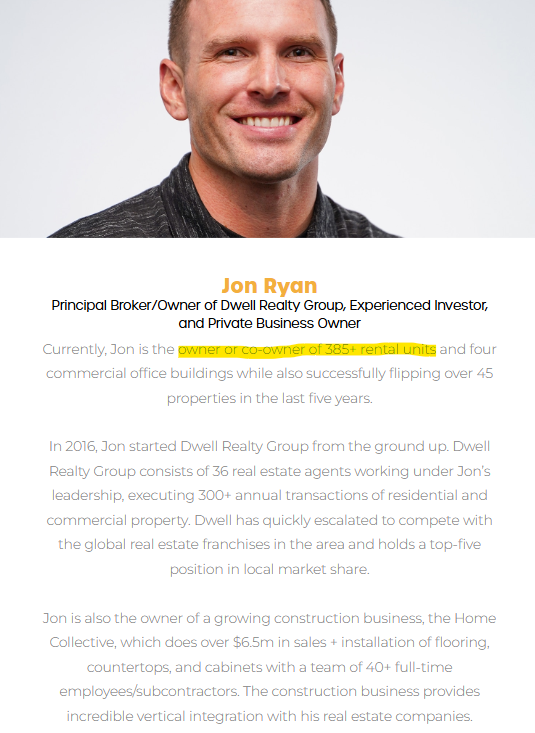
For comparison purposes, Dwell Capital/Harbor Realty & Management Group (formerly Dwell Property Management) has a very similar game plan when it comes to acquiring property, with all four owners (photos pictured above) owning single family homes to some capacity, but mostly multi-family buildings. They are also acquiring properties throughout Minnesota and Iowa, with four different investment offerings being closed at this current moment. All four of those listed on their website are for apartment buildings, and it doesn’t seem like they are currently looking to acquire additional single family homes outside of their own individual portfolios.
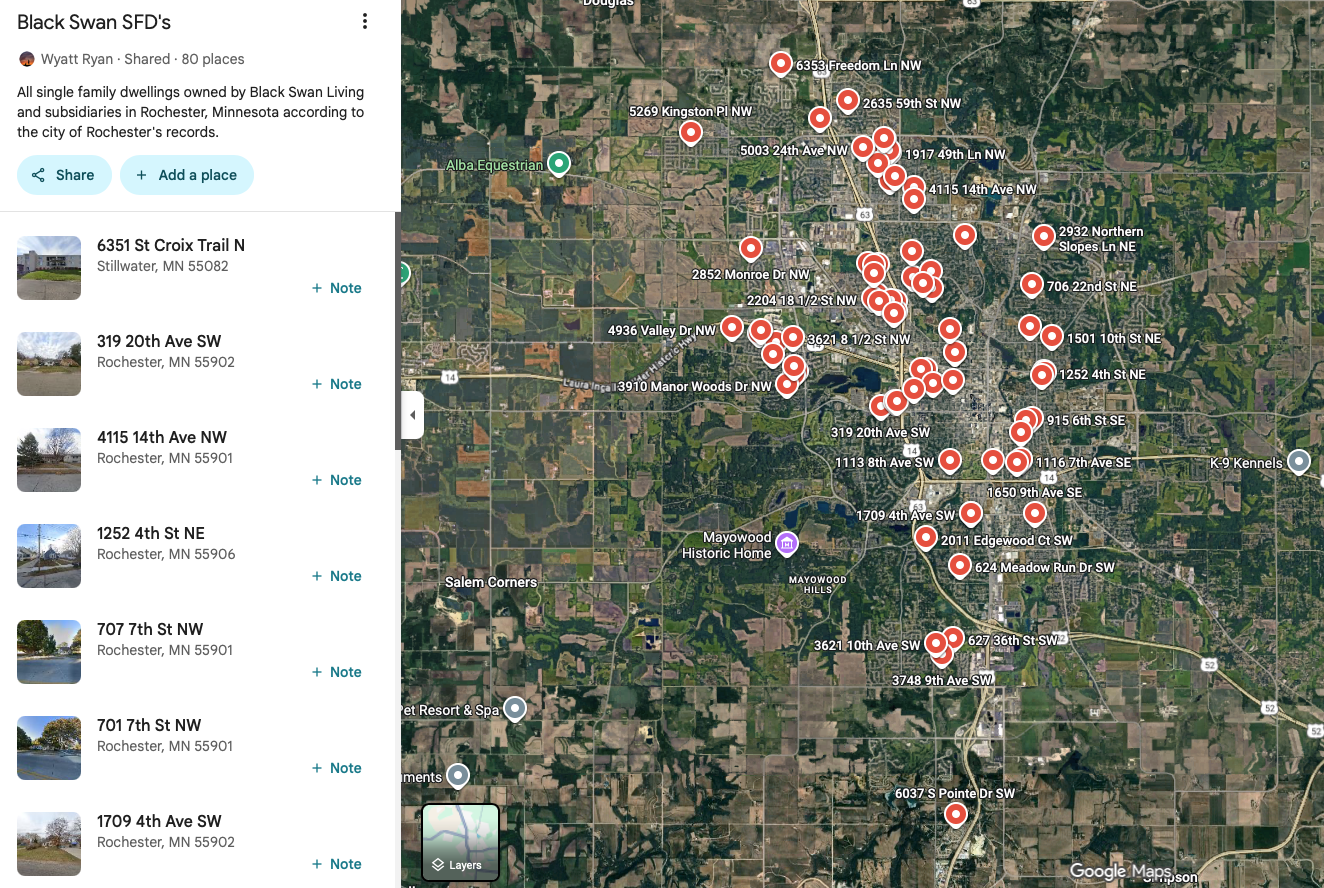
Unlike Dwell, Black Swan is currently taking investors money to acquire single family homes. And while these maps are not up to date (November of 2024), many of their single family homes are condensed near the center of Rochester, and when looking at what apartment complexes they own, the problem is even worse. At what point do you call a monopoly a monopoly? (compared to what? A lot of red dots, but you’re only showing one color)
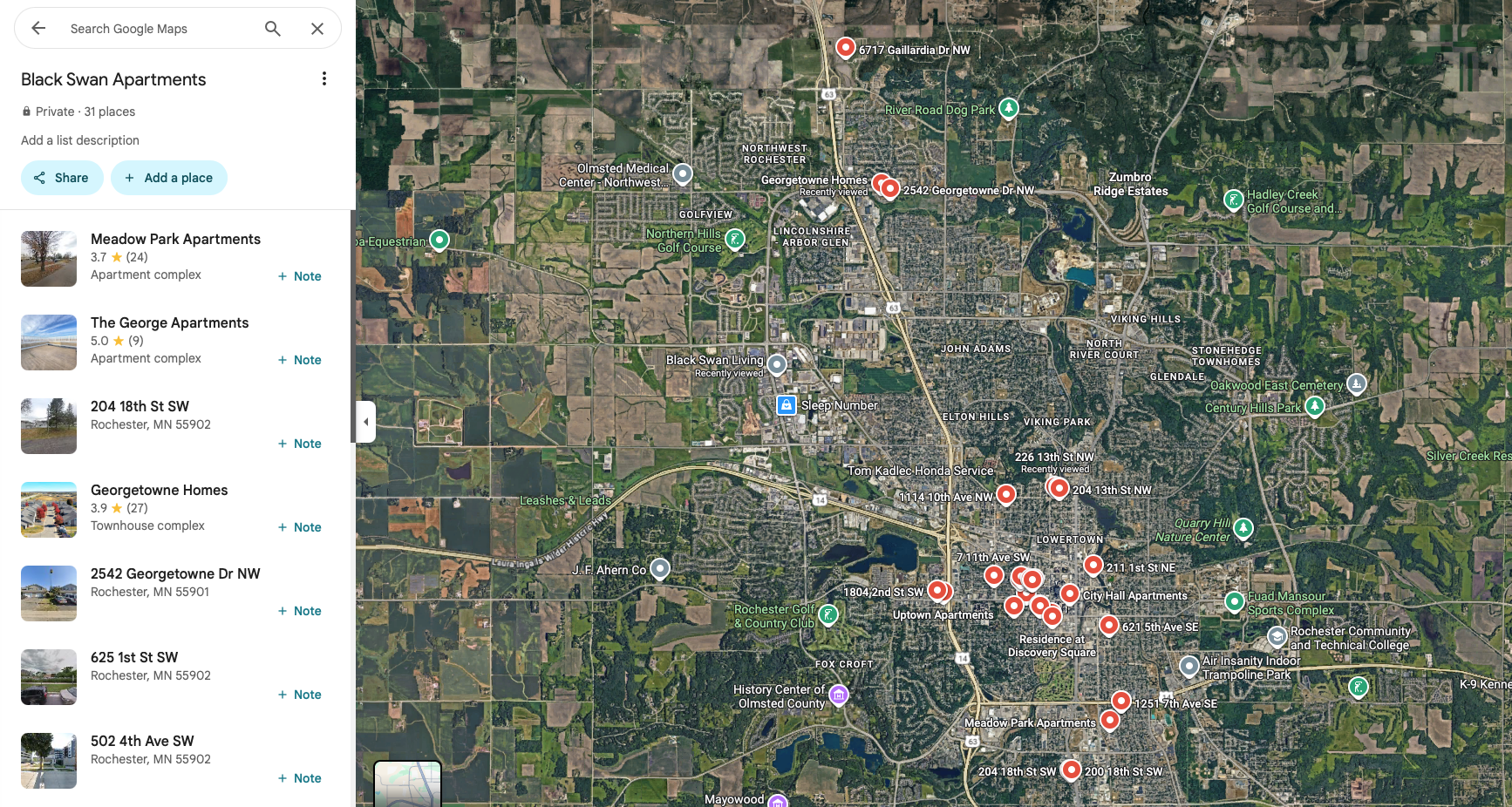
What’s even harder to show is how truly condensed their apartments are in the downtown area. With 15 apartments less than half a mile from either of the Mayo Clinic campuses, it’s easy to see what demographic they have targeted, both for tenants and their investors.

The parking lot seen just south of the 502 4th Avenue SW home, part of the outdoor parking for Residence at Discovery Square, was once a 5 bedroom home, that was torn down to create said parking lot.
To date, Black Swan has supposedly acquired over 1,300 properties in total, many of them amassed in Rochester, but also the southeastern Minnesota area. They have recently acquired property in Anoka, Minnesota, as well as Tacoma, Washington, which they also call a “blue ocean market.” As their reach of acquired properties spreads, so too do their employees, meaning issues experienced by tenants are typically dealt with less than immediately. Multiple tenants have had issues with their refrigerators not working for weeks at a time, gaping holes left in ceilings above a shower for over a month, and even disasters such as my building (Nicholas Apartments) being filled with carbon monoxide, and Black Swan not responding to multiple points of contact well before the carbon monoxide alarms started going off. If you’d like to hear that story, you can go watch my video on it here. And fun fact, the same thing happened at another one of their properties (Nue 52) that same month.
Black Swan’s initial idea behind acquiring these properties themselves was an honorable thought, though it quickly devolved. The original idea, the one that I was sold and bought into, was that because they own these rental properties, they want to take great care of them, make great renovations that last a long time, and make sure their tenant’s experiences match the ones they wish they had when they had moved to Rochester in 2016.
When I moved into one of their properties with my sister in August of 2023, I came to face the realization that not only were they just like every other property management company I had ever rented from, they were also pushy for positive reviews, slow to communicate, and dismissive of issues when they were brought up. Renovations were done cheaply, with our entire countertop in the kitchen not properly seated, and able to be fully picked up and moved. Cheap drywall and paint adorned the apartment, peeling any and all paint and paper off the walls while using “non-destructive” command strips to hang things on our walls.
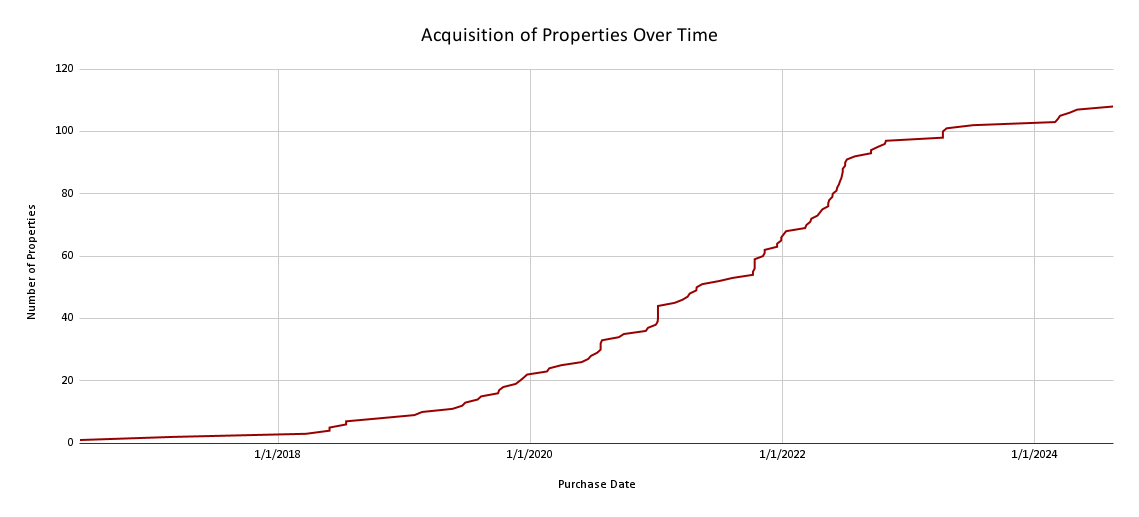
From the beginning of 2021, to the end of 2023, Black Swan acquired 59 additional properties in Rochester, Minnesota, 41 of which were single family homes.
Some may say that I’m a little jaded from my experience renting from Black Swan, and to that I say, “Of course. Who wouldn’t be?” They changed financial agreements outside of those stated in our lease, they filled our building with carbon monoxide and refused to take accountability, they left people without a way to have fresh food in their apartments for weeks at a time, failed to answer the emergency phone line, failed to make repairs in a timely manner, and so on and so on. In what world are any of these actions okay? As a tenant, I’d stay as far away from Black Swan as I possibly could.
While Black Swan Living is the manager of all of these rental properties, Black Swan Real Estate (and their couple dozen subsidiaries and DBA’s) act as the buyer and owner of all of these properties. As an investor, I’d say the same as I said for tenants, stay FAR AWAY. Whispers from realtors around Rochester have told me that fewer and fewer people are willing to work with them, and are actively trying to distance themselves from Black Swan and what they’re doing in our community. The Black Swan name is slowly becoming tainted, and it’s beginning to rot from the inside out. And with coming housing legislation in Minnesota, their business plan is at further risk of collapsing under its own weight, offering nothing to investors but the forfeiture of funds and contributing to the housing crisis in our community, both with rental price increases and lack of available affordable housing for first time home buyers.
With a name like Black Swan (see definition: an unpredictable or unforeseen event, typically one with extreme consequences), the collapse of Black Swan seems almost inevitable.
If they truly want to contribute to our community, and make it a more fair and equitable place to live for everyone, they need to focus on building new properties like they did with the Stonehaven Apartments and Townhomes in Byron, Minnesota. A change of tune in this direction could save this company, allow investors to actually help the communities Black Swan operates in, and contribute to a better society where people can actually afford housing once again.
As Rochester city councilman, Nick Miller, said to me, “the most affordable homes have already been built.” Divestment from these single family homes will allow people to make life changing choices at an affordable price, truly become a part of the community, their neighborhoods, their streets, and escape the endless cycle of renting when they’re ready. We can’t do that when every opportunity to buy a home is overtaken by a company paying cash, driving the average cost of a home up, and limiting supply of available homes to purchase.
If you’d like to know more about housing needs and analysis in Rochester, please check out the 2025 Maxfield Study that was conducted.